
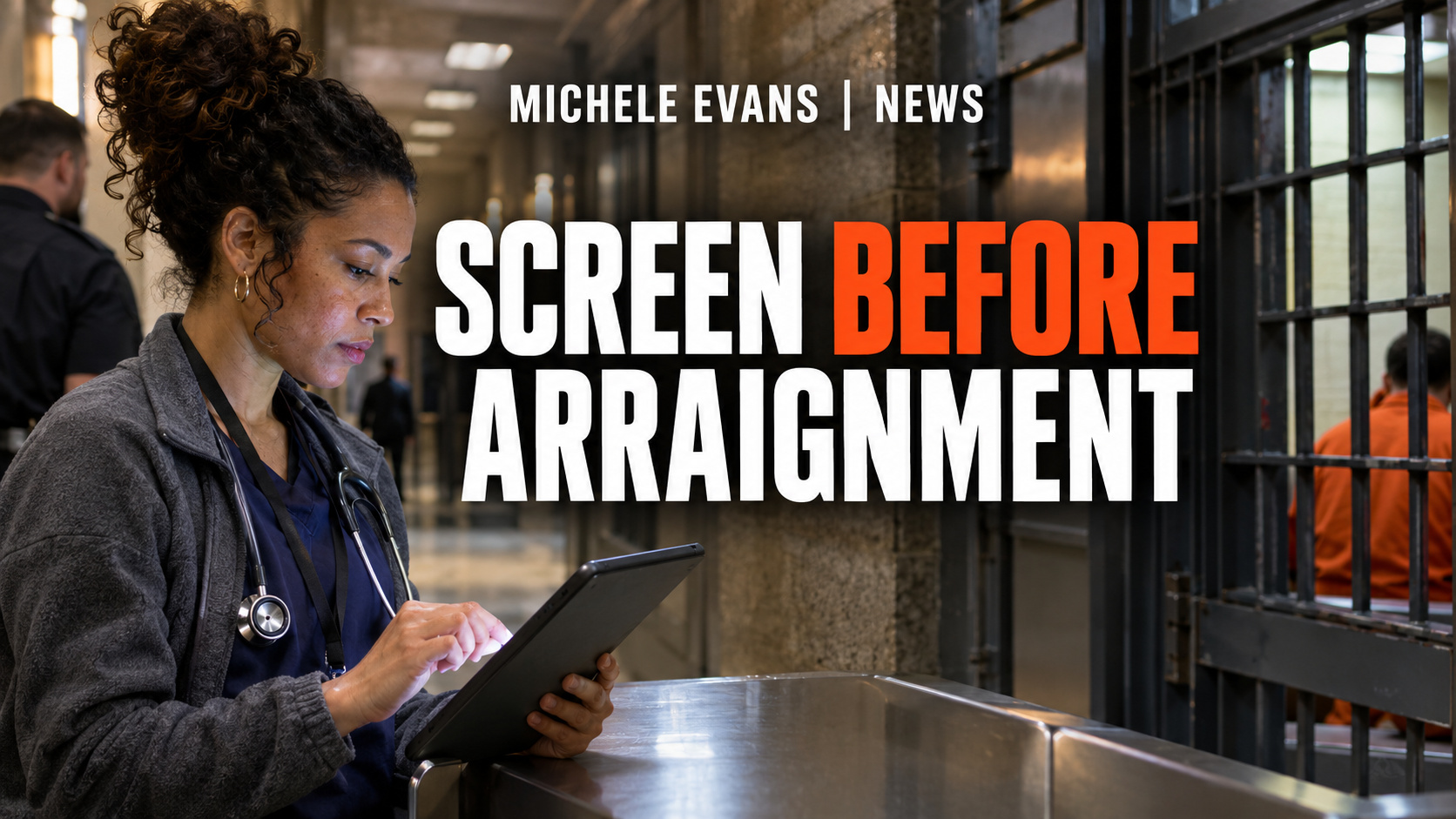
By Michele Evans / NYweeklyRecord.com / Date: 11/16/2026
Category: Criminal Courts / Mental Health / Justice Reform
NEW YORK CITY, NY – A new City Council bill would require a two-step physical and behavioral health screening for people held in central booking before arraignment, placing medical assessment earlier in the criminal court process.
Introduction 1176, sponsored by Council Member Lynn Schulman and introduced Nov. 12, is now in the Council’s Health Committee. It is a proposal, not law. No hearing date or vote has been announced.
The bill would require a health care provider to use an electronic screening tool for consenting arrestees in central booking. A patient care associate would conduct an initial screening for urgent physical and behavioral health needs. People flagged at that stage would receive a second review by a nurse practitioner.
The measure also calls for access to two existing databases. One is eClinicalWorks, the city jail health record system. The other is the state Psychiatric Services and Clinical Knowledge Enhancement System, known as PSYCKES, which contains Medicaid-related behavioral health information.
That access matters because a person can reach central booking with a chronic illness, a psychiatric history, a recent injury or a medication need that may not be obvious during intake. The bill is designed to put more information in front of clinicians before arraignment decisions are made.
The proposed system would operate around the clock. Each borough’s central booking facility would eventually have at least one nurse practitioner, one patient care associate and one diversion liaison. The city would phase in one facility per borough per year until all five boroughs are covered.
The diversion liaison would be a licensed social worker. With the arrestee’s consent, that worker could identify behavioral health needs, contact community providers and share a clinical summary with defense counsel. The purpose is to help lawyers and courts evaluate treatment, supervised release and other alternatives to detention before or after arraignment.
For people sent to jail, the bill would require health information from central booking to follow them into Department of Correction custody. A clinician could place a triage flag in eClinicalWorks when an arrestee needs follow-up after disclosing a chronic illness, experiencing an adverse health event or showing warning signs that require another assessment.
The proposal attempts to address a dangerous handoff. Central booking is controlled by the criminal court process, while jail intake is handled by correctional health services. When information does not move with a person, medication needs, mental health symptoms and other risks can be missed or delayed.
Consent is written into several parts of the bill, including screening, access to PSYCKES and communication with defense counsel. The legislation also allows health information to be shared with the Department of Correction when a person enters jail custody.
Still unanswered are the cost, staffing plan and privacy safeguards. The bill does not yet come with a public budget estimate. It also does not explain how the city would recruit enough clinicians and diversion liaisons to maintain 24-hour coverage in every borough.
Those questions should be tested in a public hearing. The Council will also need to examine how consent is obtained from people in custody, how records are limited to necessary information and what happens when an arrestee declines screening.
The stakes are immediate. Arraignment can determine whether a person goes home, enters supervised release, receives treatment or is sent to Rikers Island. A health crisis identified before that decision can change what the court sees and what services become available.
Introduction 1176 would not guarantee diversion or release. It would create a more formal process for finding medical and behavioral health needs before the system makes one of its earliest and most consequential decisions.
Leave a Reply