
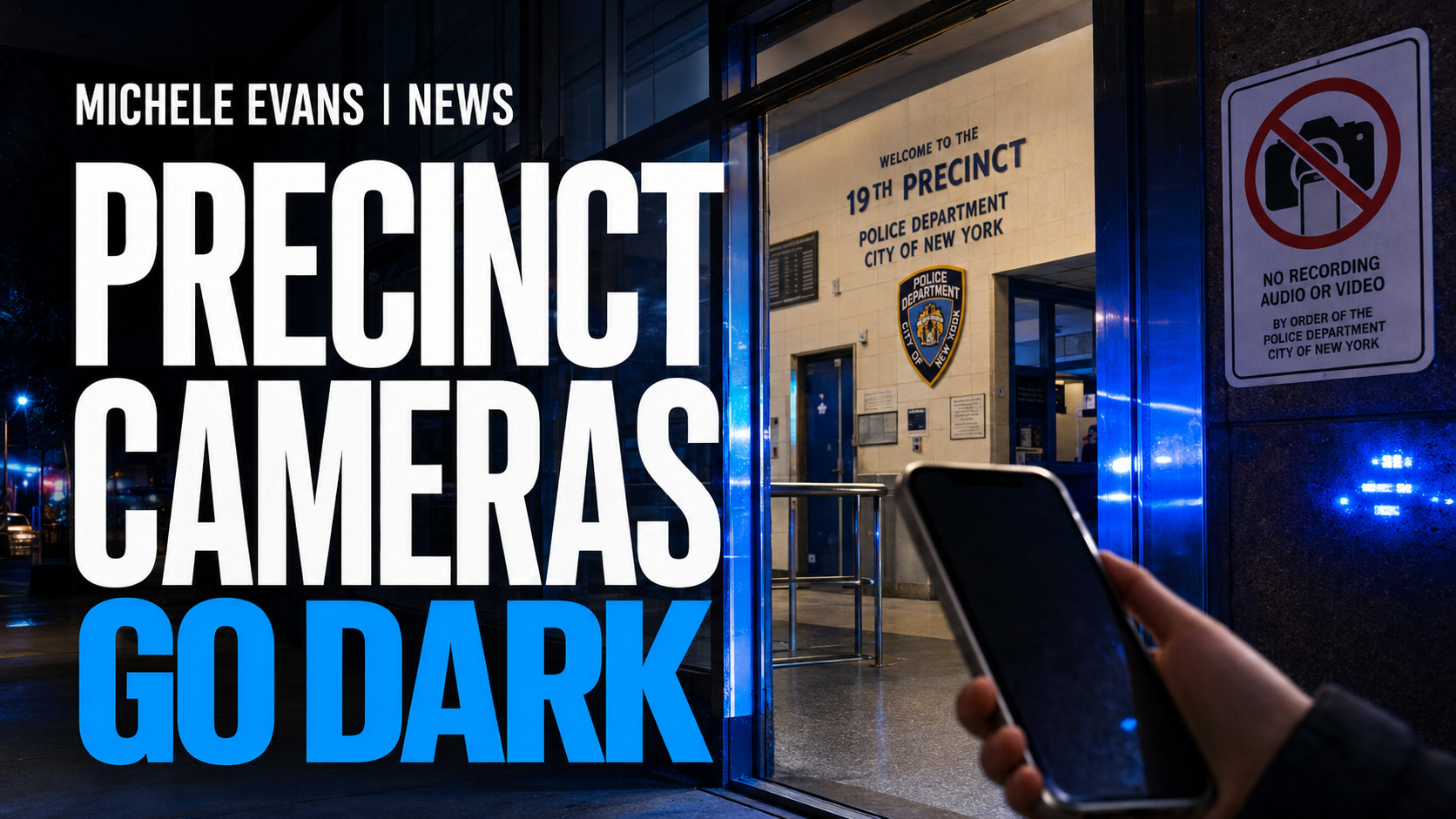
By Michele Evans / NYweeklyRecord.com / Date: 7/14/2026
Category: Criminal Courts / NYPD Accountability / Civil Rights / Government Transparency
NEW YORK CITY, NY –
New York’s highest court has drawn a hard line around a place where police power is often at its most concentrated: the stationhouse lobby.
In a unanimous ruling in Reyes v. City of New York, the New York Court of Appeals held that the state and city Right to Record Acts do not give members of the public a statutory right to film police activity inside publicly accessible police stationhouse lobbies.
The decision is narrow, but its accountability impact is significant. The court interpreted two laws enacted in 2020 to protect people who record law enforcement. It did not decide whether the NYPD’s blanket ban on recording inside police facilities violates the First Amendment. That constitutional claim remains unresolved in federal court.
SeanPaul Reyes, a self-described independent journalist who posts videos under the name Long Island Audit, entered the NYPD’s 61st Precinct in Brooklyn after receiving a tip that people were being arrested for recording in the lobby. According to the Court of Appeals opinion, an officer pointed to a sign announcing the NYPD policy against video recording inside police facilities and told Reyes to stop recording or leave.
Reyes continued recording after multiple warnings. Officers arrested him, held him for about six hours and charged him with trespass. Prosecutors later declined to prosecute, and the charge was dismissed. Reyes then sued the city in federal court, asserting claims under the First Amendment and the state and city Right to Record Acts.
A federal judge initially granted a preliminary injunction restricting enforcement of the NYPD recording ban in precinct lobbies. On appeal, the U.S. Court of Appeals for the Second Circuit asked New York’s top court to decide whether the two state and city statutes covered publicly accessible stationhouse lobbies.
The Court of Appeals answered no.
Judge Jenny Rivera, writing for the court, said both laws are broad about who may record and what police activity may be recorded, but silent about where the right applies. The judges treated that silence as an ambiguity and turned to legislative history.
The court found that lawmakers repeatedly discussed recordings made on streets, sidewalks and other outdoor public spaces. The opinion cited footage of Eric Garner’s fatal encounter with NYPD officers on Staten Island and George Floyd’s murder in Minneapolis as central examples behind the legislation. Neither the legislative debates nor the cited federal cases focused on filming inside a police stationhouse.
The judges also accepted the city’s concerns about victims, witnesses, confidential informants and undercover officers who may be present in precinct lobbies. The court noted that officers turn off body-worn cameras when victims of sensitive crimes, including domestic violence, sexual assault and human trafficking, enter a stationhouse to report what happened.
Those privacy interests are real. So is the accountability problem created when the government can control nearly every camera inside a building where officers question, detain, arrest and interact with members of the public.
Patricia Rodney’s separate civil case illustrates that tension. Rodney alleged that she went to Brooklyn’s 62nd Precinct in 2020 to obtain a police report needed to replace a lost glucometer. According to her lawsuit and NY1’s reporting, officers refused her request, ordered her to leave and arrested her after she said she was recording them. Her suit alleged that officers twisted her arms, fractured her elbow and hospitalized her. Body-worn camera footage obtained by her lawyer captured the encounter.
Rodney’s allegations were not part of Reyes v. City of New York, and the Court of Appeals made no factual or legal finding about her case. Her lawsuit is relevant only as context for the larger public-interest question: what independent evidence exists when alleged misconduct happens inside a precinct lobby and police control the recording rules?
The ruling does not declare every recording ban inside a precinct constitutional. It holds only that Civil Rights Law § 79-p and New York City Administrative Code § 14-189 do not themselves create a right to record in publicly accessible police stationhouse lobbies.
That distinction now matters. Reyes’s federal First Amendment claim remains alive, and the federal courts must still decide whether the NYPD policy satisfies constitutional requirements. The New York Court of Appeals expressly said the First Amendment issue was not before it.
For lawmakers, the decision exposes a statutory gap. If the Legislature or City Council intended the Right to Record Acts to cover public areas inside police facilities, the court says the existing language does not clearly do that. Closing that gap would now require new legislation, a successful constitutional challenge or a change in NYPD policy.
For everyday New Yorkers, the bottom line is blunt: a precinct lobby may be open to the public, but under this ruling, that does not make it a place protected by New York’s Right to Record Acts.
Leave a Reply