
New York High Court Draws Miranda Line After Police Question Injured Man
By Michele Evans / NYweeklyRecord.com / Date: 11/25/2026
Category: Criminal Courts / Police Accountability / Civil Rights / Search and Seizure
NEW YORK CITY, NY – New York’s highest court has ruled that police crossed a constitutional line when they questioned an injured man in his backyard without reading him his Miranda rights, while officers surrounded him with guns drawn and refused his requests to see his wife or go to the hospital.
The Court of Appeals ruled Tuesday in People v. Ricardo Casiano that the circumstances amounted to custody, not a routine investigative encounter. Statements Casiano made in the backyard should have been suppressed, the court held. The case now returns to Monroe County Supreme Court for further proceedings over statements police later obtained at a hospital.
The ruling forces courts and police to look at what officers actually did, not simply what they called the encounter. A person does not have to be handcuffed or formally told that they are under arrest before Miranda protections attach.
Rochester police responded to reports of gunfire at about 10:30 p.m. on August 24, 2020. Officers heard shots and saw a person on the roof of a detached garage near Casiano’s home. Within seconds of entering the backyard, they found Casiano on the ground with a broken leg.
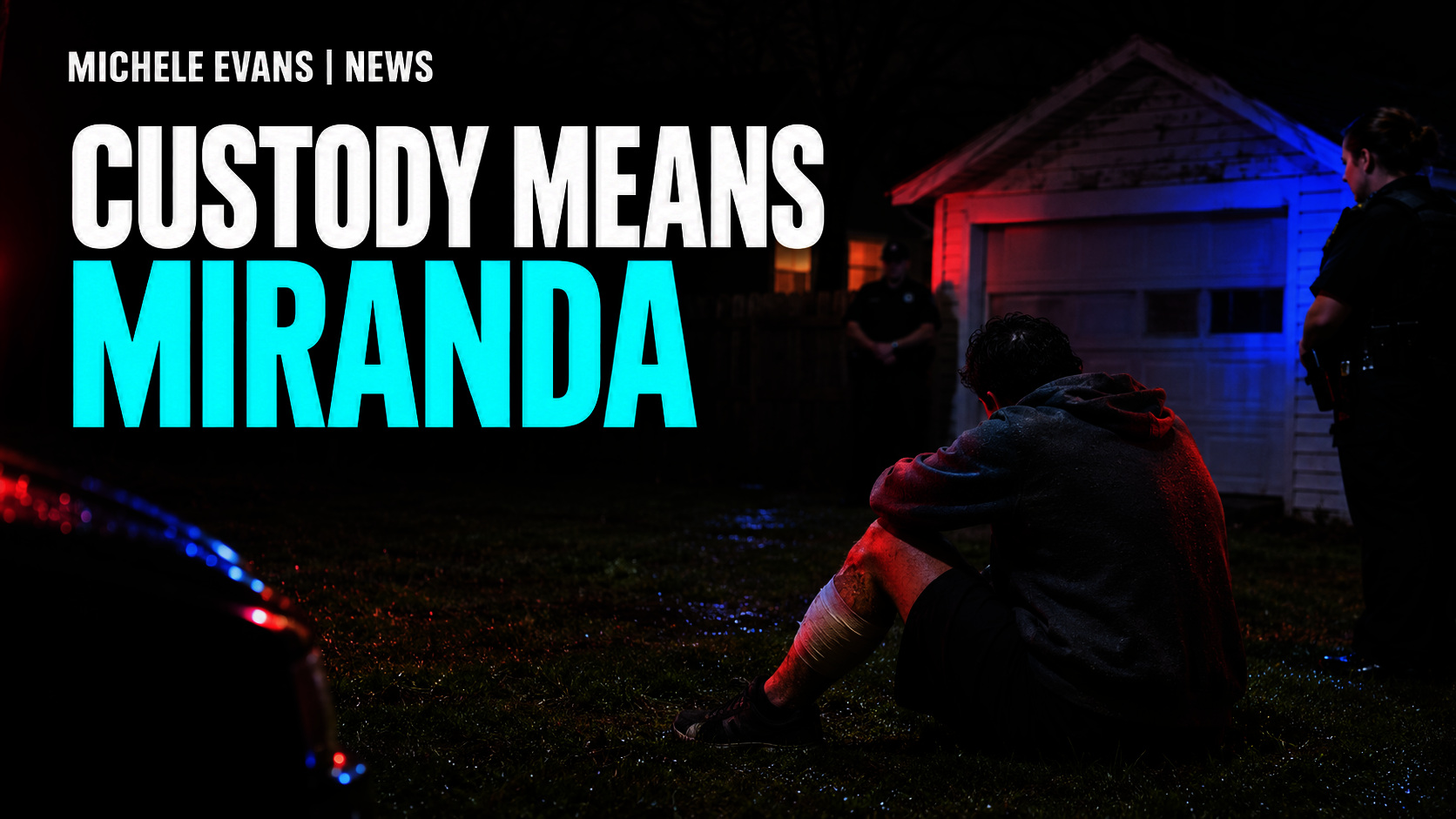
Officers approached with their weapons drawn, ordered Casiano not to move and guarded him while other officers searched for a gun, according to the court’s opinion. Casiano asked to go inside and speak with his wife. Police refused. He asked to be taken to a hospital. Police told him he had to remain in the yard until they found the weapon.
During the nearly hour-long detention, officers repeatedly questioned Casiano about the gun. He made statements indicating that he had acted to protect his family after a neighbor stabbed his son. Police later questioned him again while he was receiving treatment at the hospital. There, he made additional statements about the shooting and said he had purchased the gun years earlier.
Casiano was charged with two counts of second-degree criminal possession of a weapon. Before trial, he asked the court to suppress both sets of statements, arguing that officers had subjected him to custodial interrogation without giving Miranda warnings. The trial court denied the motion, and a jury convicted him.
The Appellate Division affirmed. Its majority characterized the backyard questioning as a noncustodial investigative inquiry. One justice dissented, concluding that the police questioning was custodial and improper. That dissent opened the door for review by the Court of Appeals.
Writing for the court, Judge Anthony Cannataro said the record permitted only one conclusion: Casiano was in custody in the backyard. The court pointed to the drawn guns, the officers surrounding him, direct commands not to move and repeated refusals when he asked to leave, speak with his wife or obtain medical treatment.
Under those circumstances, the court said, a reasonable person innocent of wrongdoing would not have believed they were free to leave. Casiano’s freedom had been restricted to the degree associated with a formal arrest, even though police had not placed him in handcuffs.
That distinction matters because Miranda safeguards apply when police interrogate a person in custody under circumstances likely to produce an incriminating response. The prosecution conceded that the questioning was likely to do exactly that. The dispute was whether Casiano was in custody.
The court rejected the lower courts’ reliance on the investigative purpose of the questioning. Calling questions investigative does not remove the duty to give Miranda warnings when police have already imposed arrest-like restraints.
The decision does not end the prosecution. The majority said the record was not developed enough to determine whether Casiano remained in custody at the hospital or whether the earlier unlawful questioning affected the voluntariness of his later statements. Monroe County Supreme Court must now address those issues.
If the hospital statements were independent and admissible, the judgment may stand. If they resulted from a continuous chain of custodial questioning that began in the backyard, the court said a new trial must be ordered.
Judges Jenny Rivera, Shirley Troutman and Caitlin Halligan joined Chief Judge Rowan Wilson and Judge Cannataro in the result. Judges Madeline Singas and Michael Garcia dissented. The dissent argued that any error involving the backyard statements was harmless because the prosecution had overwhelming evidence and that the existing record supported admitting the hospital statements.
The decision’s reach goes beyond Casiano’s case. Police frequently make urgent decisions during volatile scenes, and officers may ask questions necessary to secure people and locate weapons. But the ruling makes clear that public-safety pressure does not erase constitutional custody rules once police restrain someone to the degree associated with arrest and ask questions designed to produce evidence.
For everyday New Yorkers, the lesson is direct: the label attached to a police encounter does not control. Courts must examine whether officers physically and practically prevented a person from leaving. A person injured on the ground, surrounded by armed officers and denied medical transport is not participating in a voluntary conversation simply because no officer has announced an arrest.
The unanswered question now is whether the hospital interrogation can be separated from what happened in the backyard. That factual determination will decide whether Casiano’s convictions remain intact or whether prosecutors must try the case again without the disputed statements.
Sources
New York Court of Appeals, People v. Ricardo Casiano, November 24, 2026
Leave a Reply