
By Michele Evans
NYweeklyRecord.com
9/3/2026
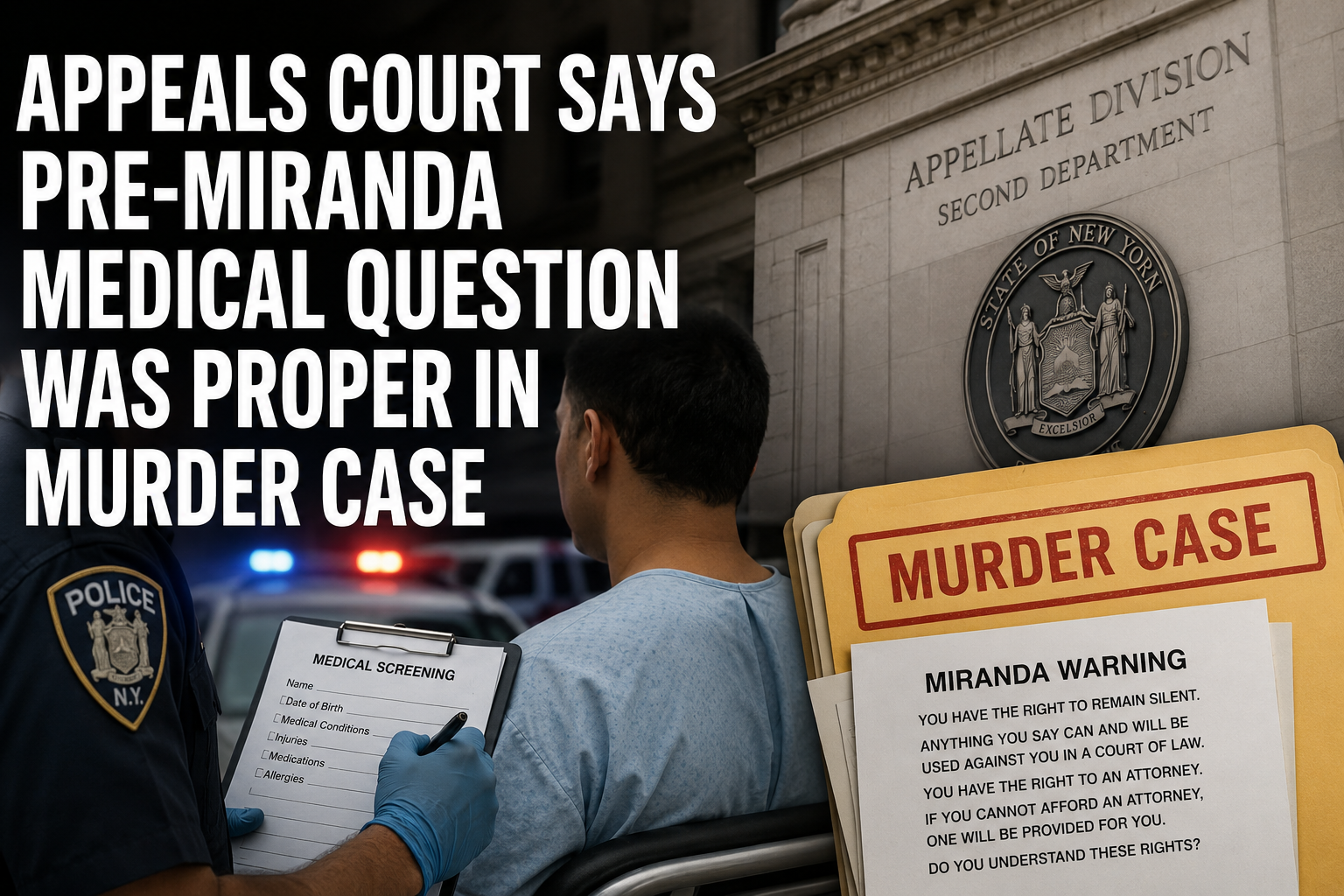
NEW YORK CITY, NY – A New York appeals court has upheld a murder conviction after ruling that a police officer’s pre-Miranda question about a suspect’s physical condition was routine medical processing, not a disguised interrogation.
The Appellate Division, Second Department, affirmed Jose Franco-Martinez’s Nassau County conviction for second-degree murder in a decision issued Wednesday.
Franco-Martinez argued that a statement he made to a police officer and police medic before receiving Miranda warnings should have been suppressed. He also argued that the early questioning invalidated a later waiver of his rights.
The court said pedigree questions may be asked without Miranda warnings when they are limited to information needed to process a person in custody or address physical needs. The key safeguard is whether police use a routine question as a cover for an investigative inquiry.
Here, the judges found that the question concerned Franco-Martinez’s current physical condition and was appropriate for processing him. The record contained no evidence that the officer or medic asked it to produce an incriminating response.
Because the initial statement was not obtained through improper interrogation, the court ruled that it did not taint Franco-Martinez’s later Miranda waiver.
The decision draws a narrow but important boundary. Police may ask about immediate medical or booking needs before warnings, but they cannot repackage questions designed to gather evidence as routine processing.
The court also found the evidence legally sufficient to establish intent to kill and concluded that the verdict was not against the weight of the evidence. The jury had rejected Franco-Martinez’s claim that he acted under an extreme emotional disturbance when he stabbed and killed the victim.
Judges deferred to the jury’s assessment of conflicting expert testimony and found that Franco-Martinez had not shown a reasonable explanation or excuse for the claimed disturbance.
The panel further ruled that challenged comments by the prosecutor during summation were either permissible argument or not serious enough to deny a fair trial. It rejected the ineffective-assistance claim and found the sentence was not excessive.
The ruling does not create a blank check for pre-warning questioning. It reinforces a fact-specific test focused on purpose: whether the question genuinely serves custody and medical needs or is intended to investigate a crime.
The decision is uncorrected and may be revised before publication in the Official Reports.
Leave a Reply