
By Michele Evans
NY Weekly Record
August 28, 2026
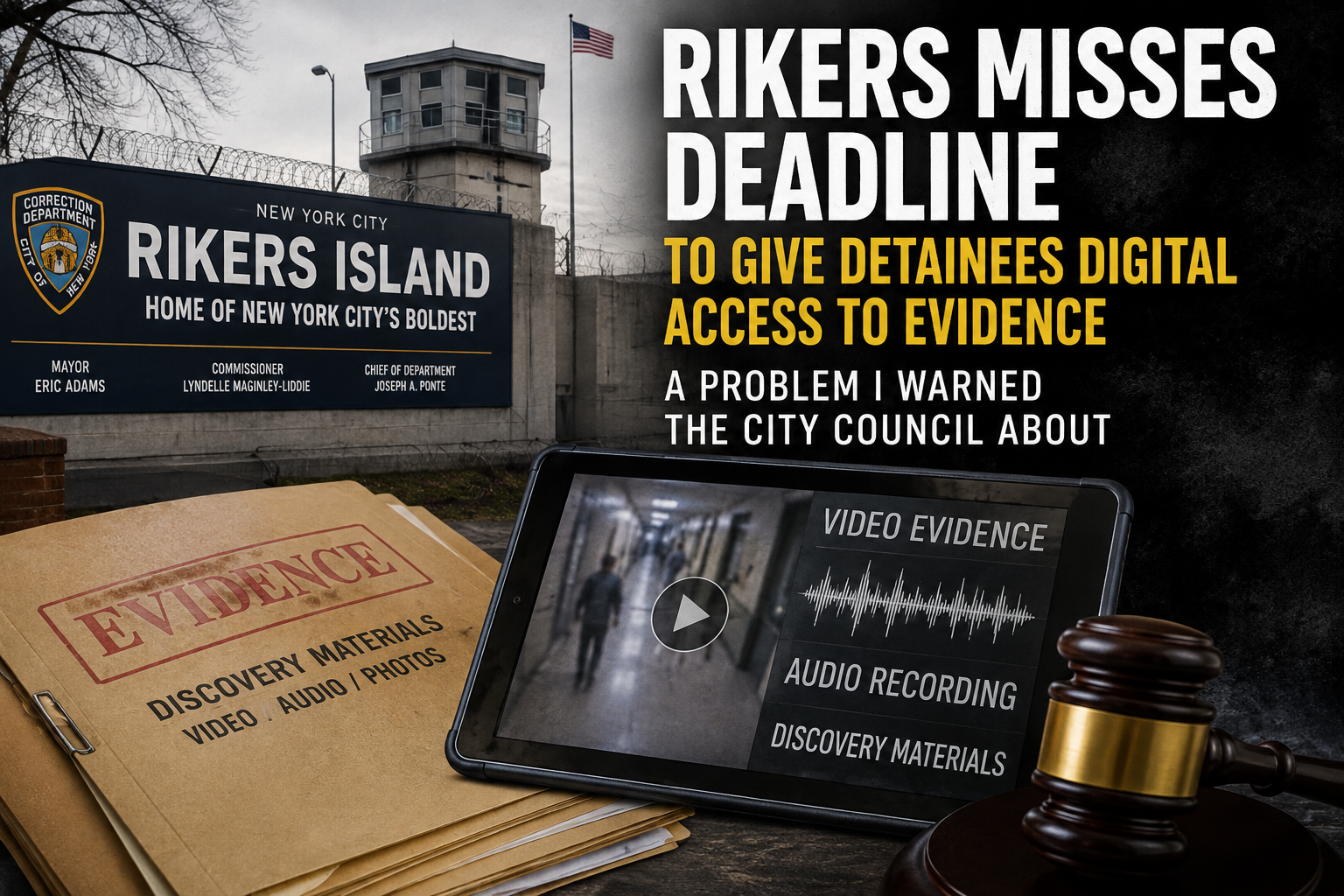
NEW YORK CITY, NY – New York City’s Department of Correction has missed a legally mandated deadline to give people detained on Rikers Island meaningful digital access to evidence in their criminal cases, including videos, audio recordings and other electronic discovery.
For me, the issue is not abstract.
I testified before City Council about my own experience being incarcerated and unable to adequately access evidence connected to my criminal case. I told lawmakers what it means to be expected to participate in your own defense while the material necessary to understand that defense remains effectively beyond your reach.
Luckily, the City Council recently enacted legislation requiring the Department of Correction to provide people in custody with a secure means of reviewing electronic discovery. DOC was given nine months to implement the system, with a deadline of July 1, 2026.
That deadline has passed.
The consequences potentially affect thousands of people. Approximately 85 percent of the nearly 6,500 people incarcerated on Rikers Island are awaiting trial. They have not been convicted of the charges keeping them there.
Yet those detainees are expected to make some of the most consequential decisions of their lives — whether to accept a plea offer, whether to proceed to trial, what information to provide their attorneys and how to challenge the government’s evidence.
Doing that without meaningful access to the evidence itself creates an obvious problem.
Electronic discovery is now fundamental to criminal litigation. A case may involve surveillance footage, body-camera video, recorded telephone calls, photographs, digital communications and hours of other audiovisual material.
Being told what a video supposedly shows is not the same thing as watching it.
Being told what somebody allegedly said on a recording is not the same thing as hearing it.
And relying entirely upon an attorney to describe potentially enormous quantities of discovery is not equivalent to allowing an accused person to examine the evidence and participate meaningfully in preparing a defense.
That was the reality I experienced.
Existing alternatives on Rikers have included receiving paper discovery through the mail and attempting to review electronic material through computers in jail law libraries. People in custody can also communicate with their attorneys through telephone calls, video conferences and in-person visits.
But those mechanisms do not necessarily provide practical, sustained access to large quantities of electronic evidence.
Councilmember Jennifer Gutiérrez, the legislation’s lead sponsor, said when the measure passed that people in custody face enormous barriers to defending themselves and that a lack of access can make meaningful participation in their own defense extraordinarily difficult.
The legislation was supposed to change that.
Under the contemplated system, defense attorneys would be able to upload evidence to secure individual accounts that detainees could access through department-issued tablets or computers in jail law libraries.
DOC has yet to implement the required system.
The department says it is working to finalize a contract for the technology. Security concerns have reportedly complicated implementation, including questions about preventing detainees from accessing evidence subject to legal restrictions.
Those are legitimate issues requiring safeguards.
They do not erase the underlying problem.
A person accused of a crime is not merely an observer of his or her prosecution. The defendant is the person whose liberty is at stake.
The ability to review evidence can affect whether a defendant recognizes a person in surveillance footage, identifies an inaccurate timestamp, remembers circumstances surrounding a conversation, spots something an attorney overlooked or provides information that changes the defense’s understanding of the case.
For incarcerated defendants, however, the technological transformation of the criminal justice system has created a peculiar imbalance.
Police departments, prosecutors and defense attorneys increasingly operate in a digital world.
The person sitting on Rikers may still be trying to understand that digital case through paper, limited computer access and conversations with an attorney.
The City Council recognized that disparity and enacted legislation intended to address it.
What makes the missed deadline particularly troubling is that the problem did not suddenly emerge on July 1. People who have been incarcerated, defense attorneys, advocates and others have been describing barriers to evidence access for years.
I was one of them.
There is also no penalty contained in the law for failing to meet the implementation deadline, and no new date has been announced for when detainees will actually receive access.
That leaves an important question for the city:
How long should a person presumed innocent have to wait for meaningful access to the evidence being used to prosecute them?
I know what it is like to sit inside Rikers while trying to understand and participate in a criminal case without the access to evidence that someone outside a jail might take for granted.
I testified about it because the problem was bigger than my case.
The City Council eventually acted.
Now the law exists.
The deadline has passed.
And the people sitting on Rikers are still waiting.
Leave a Reply