
By Michele Evans
NY Weekly Record
August 26, 2026
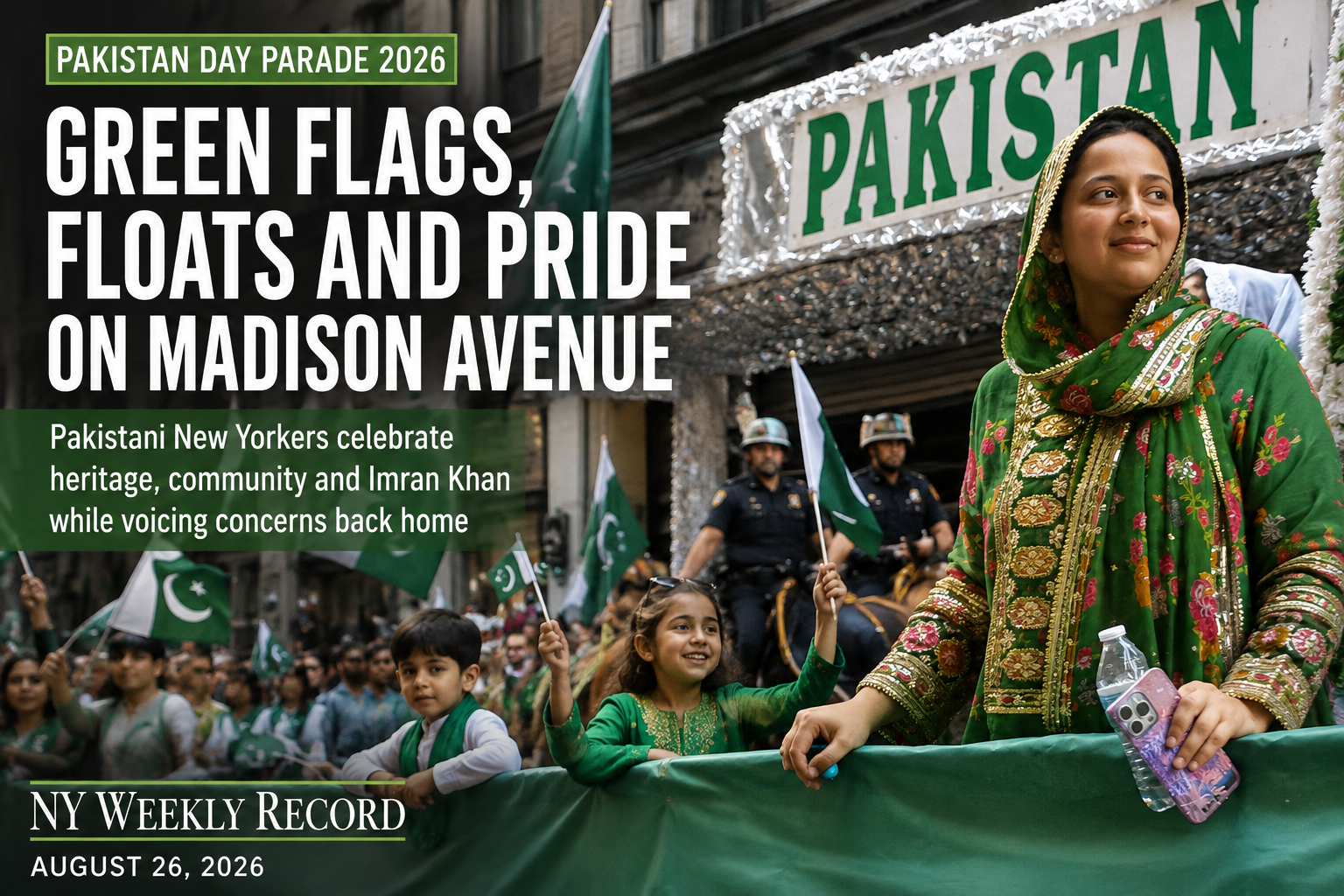
NEW YORK — Madison Avenue turned green Sunday as Pakistani New Yorkers filled Midtown Manhattan with flags, traditional clothing, music, food and brightly decorated floats for the annual Pakistan Day Parade – a celebration that mixed national pride and the pleasures of a New York summer gathering with unmistakable concern over the political turmoil back home.
For much of the day, the mood was jubilant.
Green-and-white Pakistani flags seemed to be everywhere. Families lined the parade route while children rode atop floats, waved flags and took in the spectacle. Kids stopped to pet horses as mounted NYPD officers moved through the celebration. Traditional Pakistani clothing brought splashes of color to the avenue, while the smell of food drifted through a gathering that felt as much like a large community reunion as a parade.
People were in good spirits, eating, talking, taking photographs and celebrating a Pakistani-American community that several attendees said has found a genuine home in New York.
There was also broad warmth toward New York City Mayor Zohran Mamdani among people interviewed at the celebration. Mamdani has made visible outreach to Pakistani New Yorkers, appearing earlier this month at the Pakistan Day Mela in Brooklyn, where he described it as a privilege to return to the community celebration and recognized Pakistani community leaders.
But beneath Sunday’s festivities was a much more serious subject: Pakistan itself.
The imprisonment and health of former Prime Minister Imran Khan weighed heavily on some of the Pakistanis who spoke with the NY Weekly Record.
Hafiz, who agreed to give his first name, offered one of the day’s most pointed assessments.
“The only time Pakistanis could be proud was when we had Khan as prime minister,” Hafiz said.
He described other governing regimes in Pakistan as corrupt, an opinion reflecting the deep political divisions that have followed Khan’s removal from power in 2022 and imprisonment beginning in 2023.
Those concerns have become particularly acute because of questions surrounding Khan’s health.
Just days before the New York celebration, Pakistan’s Supreme Court ordered that the imprisoned former prime minister receive medical treatment. Khan was taken from Adiala Jail for a hospital examination before being returned to prison only hours later. His Pakistan Tehreek-e-Insaf party subsequently sought contempt action, arguing that authorities had failed to comply properly with the court’s medical-care directive. Pakistani officials have disputed allegations that Khan has been denied adequate medical treatment and maintain that examinations found him medically fit.
Concern has now extended well beyond Pakistan’s partisan politics. Twenty-two former international cricket captains recently renewed an appeal for Khan to receive appropriate medical care, amid claims from his family and supporters about his health and eyesight. The Pakistani government disputes allegations of mistreatment.
For journalists, however, there is another reason conversations about Pakistani politics can become uncomfortable very quickly.
That history may help explain something noticeable along Madison Avenue Sunday: although people were friendly and often willing to talk, a number of attendees were reluctant to provide their full names when the conversation turned toward Pakistani politics.
The killing of Pakistani investigative journalist Arshad Sharif remains an especially chilling backdrop.
Sharif fled Pakistan in 2022 after facing sedition-related cases and threats. Imran Khan later publicly said that he had twice advised Sharif to leave Pakistan because Khan believed the journalist’s life was in danger. Sharif ultimately traveled to Kenya, where Kenyan police shot and killed him on Oct. 23, 2022. Kenyan authorities initially described the shooting as a case of mistaken identity.
The legal consequences of that killing remain unresolved years later.
In July, Kenya’s Supreme Court dismissed an appeal brought by Sharif’s widow and journalism organizations challenging portions of an appellate ruling, including the refusal to compel prosecution of the police officers involved, increase damages and require a public apology.
Against that history, reluctance by ordinary paradegoers to attach their full names to political criticism was understandable. Some conversations simply stopped short when the subject became sensitive.
Yet that caution did not overwhelm the celebration.
Sunday was ultimately a day of two Pakistans existing simultaneously on Madison Avenue: the Pakistan represented by political uncertainty, imprisonment and concerns about press freedom, and the Pakistan represented by families, children, food, music, colorful clothing and a sea of green flags moving through the heart of Manhattan.
For the Pakistani New Yorkers gathered there, affection for their homeland appeared to coexist easily with affection for their adopted city.
The message heard repeatedly was a simple one: the Pakistani community loves it here.
And for a few hours Sunday, amid children riding floats, families sharing food and youngsters reaching out to pet horses along the parade route, a piece of Pakistan was unmistakably at home in New York.
Leave a Reply