
Defense Uses Guilty Plea, Carro’s Own Scheduling Statements and the Manafort Case in Bid to Gut Manhattan Murder Prosecution
By Michele Evans
NYWeeklyRecord.com
August 14, 2026
NEW YORK — Luigi Mangione’s newly filed motion to dismiss his Manhattan murder case is far more sweeping than a conventional double-jeopardy challenge.
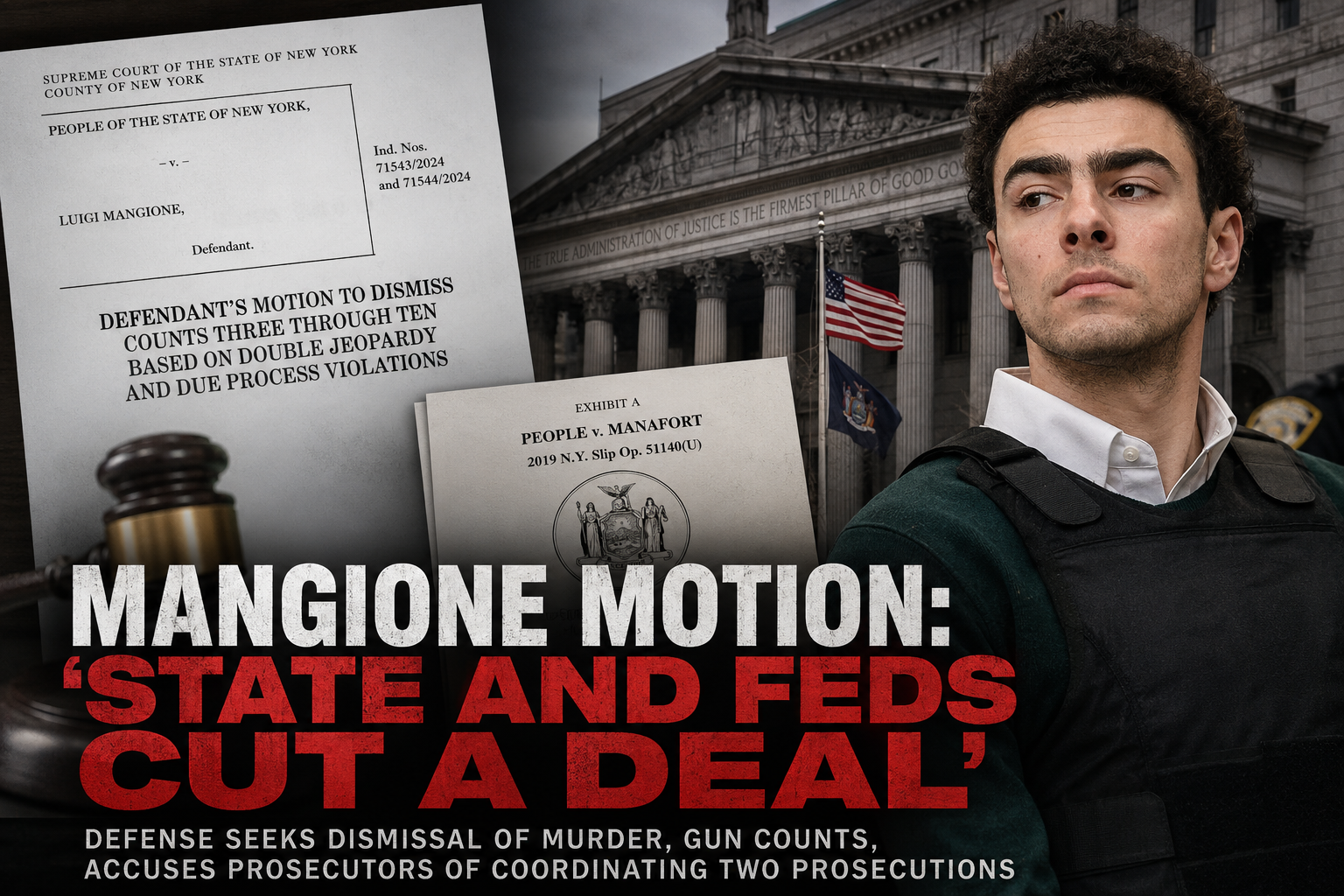
In a 32-page affirmation filed Friday, with a 2019 double-jeopardy ruling in the Paul Manafort case attached as an exhibit, Mangione’s attorneys argue that his federal guilty plea does not merely create a potential obstacle to his upcoming state trial.
They contend it legally transforms the Manhattan prosecution into an impermissible second prosecution under New York law.
And they make an even more explosive constitutional argument: that state and federal authorities deliberately coordinated the order of the two cases so both governments would get a chance to prosecute Mangione for the same killing.
The defense wants Judge Gregory Carro to dismiss the remaining second-degree murder charge, Count Three, along with firearms Counts Four through Ten. The only charge the motion would leave untouched is Count Eleven, involving an allegedly fraudulent identification card, which the defense says arose from a separate criminal transaction.
The motion is signed by Karen Friedman Agnifilo and also lists Marc Agnifilo and Jacob Kaplan as counsel.
The Guilty Plea Is the Trigger
The first major argument turns on a distinction that could become critical: Mangione does not have to wait until federal sentencing for New York’s statutory double-jeopardy protection to potentially apply.
New York Criminal Procedure Law defines a prior prosecution to include a case that terminates in a conviction upon a guilty plea.
Mangione pleaded guilty Friday morning to the two surviving federal stalking counts. During the federal plea proceeding, according to the state motion, he admitted possessing a loaded firearm equipped with a silencer and using it to shoot and kill UnitedHealthcare CEO Brian Thompson.
His attorneys argue that the plea therefore terminated the federal prosecution for purposes of Article 40 of New York’s Criminal Procedure Law.
That point matters because New York law goes substantially beyond the federal Constitution. Although federal double-jeopardy doctrine generally permits separate state and federal prosecutions under the dual-sovereignty doctrine, New York has enacted broader statutory protection against successive prosecutions based on the same act or criminal transaction.
The defense therefore is not simply arguing that Mangione cannot be prosecuted twice for the same crime.
Its argument is more precise: New York itself has chosen to restrict its power to bring a second prosecution even when the Constitution might otherwise allow one.
The Defense Has Two Different Routes
One of the most interesting features of the motion is that Mangione’s attorneys do not rely exclusively on Friday’s stalking guilty plea.
They construct two statutory routes.
The first is straightforward. The federal stalking offenses to which Mangione pleaded guilty resulted in Thompson’s death and allegedly arise from the same criminal transaction as New York’s second-degree murder charge.
The second theory reaches backward to federal Counts Three and Four, the federal murder-through-use-of-a-firearm and firearm counts that Judge Margaret Garnett dismissed earlier this year.
Those counts were dismissed before trial after Garnett concluded that the stalking offenses did not qualify as predicate crimes of violence under the particular federal statutory definition required for the firearm-based charges.
The defense nevertheless argues those dismissed counts matter under New York law because they involved the same killing and same firearm now at the center of the state prosecution.
That second route is particularly important to the firearms charges.
Mangione’s lawyers emphasize that although New York divided the weapon allegations into multiple counts based on characteristics of the firearm, the underlying object remains one gun.
Their argument, stripped to its essentials, is one firearm, one shooting, one victim and one criminal episode.
The Biggest Fight May Be Over CPL 40.20(2)(b)
The Manhattan District Attorney’s strongest statutory response is likely to come from one of the exceptions written directly into New York’s double-jeopardy statute.
CPL 40.20(2)(b) permits a second prosecution when two requirements are satisfied: each offense contains an element the other does not, and the statutes defining those offenses are designed to prevent “very different kinds of harm or evil.”
Mangione’s attorneys essentially concede the first part.
Federal stalking and New York murder are not identical offenses. Their elements differ.
But that alone is not enough.
The attached People v. Manafort decision illustrates why. The court explained that New York provides relatively broad statutory double-jeopardy protection and that different elements alone do not satisfy the exception. Prosecutors must also establish that the statutes target very different harms.
In Manafort, the court rejected attempts to distinguish state fraud offenses from federal fraud offenses when both ultimately attacked the same broad category of harm.
Mangione’s attorneys apply that reasoning to human life.
The motion relies heavily on precedent holding that statutes can address the same harm even when their elements differ dramatically. The attached decision cites Wiley v. Altman, involving a Maryland conspiracy-to-murder prosecution followed by a New York murder charge. The relevant laws were treated as directed toward the same fundamental harm: the unlawful taking of a particular human life.
That gives Mangione a considerably more sophisticated argument than simply saying both prosecutions concern the same shooting.
Under New York law, the purpose of the statutes matters.
Federal Sentencing Could Complicate the DA’s Argument
The defense also uses Mangione’s anticipated federal sentencing calculation to reinforce its contention that the federal stalking prosecution is, in practical terms, punishing Thompson’s killing.
The motion predicts that federal prosecutors will seek a Guidelines calculation tied to murder and potentially exposing Mangione to decades in federal prison.
That prediction is not a sentence, and the federal judge will ultimately determine Mangione’s punishment.
But the strategic purpose of including it is clear.
If the federal government seeks to punish the stalking offenses by treating the resulting death as murder for sentencing purposes, Mangione’s attorneys argue it becomes harder for the state to characterize the federal and state statutes as protecting “very different kinds of harm or evil.”
Garnett’s Earlier Ruling Cuts Both Ways
Judge Garnett’s dismissal of the federal firearm charges presents an obvious counterargument for prosecutors.
She concluded that the stalking offenses were not categorically crimes of violence under the controlling federal statutory definition.
The Manhattan DA can point to that ruling as evidence of the legal distinction between stalking and intentional murder.
Mangione’s attorneys anticipate the argument.
They say Garnett was answering a technical federal statutory question about whether stalking satisfied a particular definition of a crime of violence.
She was not determining whether the federal stalking statute and New York murder law address “very different kinds of harm or evil” under CPL 40.20.
That distinction could become crucial.
The prosecution can say the offenses are legally different.
The defense can answer that CPL 40.20(2)(b) already assumes the offenses have different elements. Otherwise there would be no need for the second requirement concerning the harms the laws were designed to prevent.
The Firearm Counts May Present a Separate Problem
The weapons charges present a somewhat different issue.
Mangione’s attorneys emphasize that the firearm recovered following his Pennsylvania arrest is the same firearm alleged in the federal prosecution and the same firearm underlying New York’s multiple weapons counts.
The federal indictment previously charged the use and possession of that firearm in connection with Thompson’s killing.
The defense argues that New York cannot transform the same firearm involved in the same criminal transaction into a fresh prosecution merely by charging different characteristics of the weapon under state law.
Again, prosecutors have statutory exceptions available to argue.
But factually the defense has reduced the issue to something easily understood: the federal government already prosecuted conduct involving the gun, and New York now seeks to prosecute possession and use of that same gun during the same killing.
CPL 40.20(2)(f) Is Another Potential Escape Hatch
The motion anticipates another possible argument under CPL 40.20(2)(f).
That exception addresses certain prosecutions in which an earlier out-of-state or federal proceeding terminated because of insufficient evidence concerning an element that is unnecessary to the subsequent New York offense.
The stalking guilty pleas plainly were not terminated for insufficient evidence.
But Garnett’s dismissed firearm counts create the harder question.
The defense distinguishes between evidentiary insufficiency and legal insufficiency.
Its argument is that Garnett did not examine the prosecution’s proof and conclude prosecutors lacked evidence establishing a factual element. Instead, she made a legal determination that the stalking statutes could not serve as qualifying crimes of violence under the federal firearm statute.
The defense therefore contends that the exception does not apply.
Then Comes the Constitutional Accusation
The statutory arguments alone could dramatically alter the Manhattan prosecution.
But the motion goes considerably further.
Mangione’s attorneys accuse the Manhattan District Attorney’s Office and federal prosecutors of coordinating the prosecutions so each sovereign could have its opportunity to prosecute him.
The filing says the governments effectively “cut a deal” and contends that the supposedly separate sovereigns “acted as one.”
That is an allegation by the defense, not an established factual finding.
Coordination between state and federal law enforcement is common and does not by itself eliminate the dual-sovereignty doctrine.
Mangione’s attorneys are making the more ambitious argument that officials intentionally manipulated the sequence of these particular prosecutions to preserve two opportunities to punish him while avoiding New York’s restrictions on successive prosecution.
Carro’s Own Words Are Now Part of the Argument
This is where the motion becomes particularly unusual.
Mangione’s attorneys reconstruct the history of the two cases and use statements made in Carro’s courtroom as evidence that sequencing was deliberate rather than incidental.
The motion quotes Carro saying in February that the federal government had “reneged on their agreement” to allow the state to proceed first.
The defense then points to the acceleration of the state trial and to statements from prosecutors demonstrating awareness that a federal prosecution going first could potentially jeopardize the Manhattan case.
Those statements do not establish that an unconstitutional agreement existed.
They do, however, support a narrower proposition important to the defense: the participants understood that the order of the prosecutions potentially mattered under New York double-jeopardy law.
The Affirmative-Defense Problem
The motion also connects trial sequencing to Mangione’s proposed affirmative defense in state court.
According to the defense, Mangione was required to disclose information supporting an affirmative defense unavailable in federal court.
That allegedly created a dilemma.
Disclosing the information necessary to preserve the state defense potentially could provide federal prosecutors with admissions useful against him. Remaining silent to protect the federal case could jeopardize his ability to present the state defense.
Mangione’s attorneys characterize that predicament as a due-process violation created by the coordinated prosecution schedule.
It is a novel argument.
That novelty cuts both ways.
The absence of a closely comparable case allows the defense to characterize these circumstances as extraordinary. It also means there may be no controlling precedent requiring Carro to accept the theory.
Why Manafort Matters
Attaching People v. Manafort to the filing is significant.
The Manafort court began with the recognition that federal and state constitutional double-jeopardy doctrine generally permits successive prosecutions under dual sovereignty. But New York’s Legislature chose to impose broader restrictions through Article 40 of the Criminal Procedure Law.
The court ultimately dismissed Manafort’s New York prosecution under CPL 40.20.
The cases are obviously not identical. Manafort involved financial crimes, while Mangione faces a murder prosecution.
But that is not the proposition for which Mangione’s attorneys need the case.
They need it to demonstrate that New York’s statutory protection has teeth and that merely identifying different elements in federal and state offenses does not necessarily permit successive prosecution.
Where the Defense Is Strongest
The defense’s cleanest argument may be statutory rather than constitutional.
Mangione now has federal convictions by guilty plea.
The federal and state proceedings arise from Thompson’s killing.
And New York deliberately provides broader successive-prosecution protection than the federal Constitution.
The attached Manafort decision describes CPL 40.20 as extending the prohibition to separate prosecutions based upon the “same act or criminal transaction,” subject to specifically enumerated exceptions.
The fight therefore is not over whether New York has broader protection.
It is over whether an exception applies.
Where the Motion Is Most Vulnerable
The defense nevertheless faces serious obstacles.
Federal stalking and New York intentional murder have different elements.
The District Attorney can argue that stalking statutes target stalking, harassment, fear and interstate conduct, while murder statutes target intentional homicide.
The defense responds that once the federal offense results in Thompson’s death and that death drives the potential punishment, the laws converge on the protection of human life.
That could become the central statutory dispute.
The constitutional due-process theory is more ambitious still. State and federal prosecutors routinely cooperate without becoming a single sovereign. To prevail on that theory, Mangione likely needs considerably more than evidence that the offices communicated or coordinated schedules.
And some of the filing’s most explosive language remains advocacy. Assertions that prosecutors “cut a deal” or “acted as one” are the defense’s characterization of events. The District Attorney has not yet answered those allegations in this round of motion practice.
A Judge Unlikely to Surrender the Case Easily
There is another factor in assessing what happens next, and this one comes from my own experience rather than the four corners of Mangione’s motion.
Based on my experience appearing before Judge Gregory Carro and watching him manage the Mangione prosecution from inside Part 32, I do not expect him to let this case go without a serious legal fight.
I say that with an unusual firsthand perspective: I once tried to get my own case out of Carro’s courtroom. He would not let me go.
The circumstances and legal issues in my case were entirely different from Mangione’s, and that experience does not tell us how Carro will rule here.
But it informs my assessment of the judge.
In my own dealings with Carro, I have seen a jurist willing to push back, scrutinize arguments closely and retain control of a matter when he believes it properly belongs before him.
The public Mangione record provides additional context.
The defense itself points to Carro’s statement that the federal government had “reneged on their agreement” to let the state proceed first and to the subsequent acceleration of the state trial.
That history matters now because the circumstance Carro previously found missing has changed.
The federal prosecution has resulted in guilty pleas.
Mangione’s double-jeopardy argument is no longer hypothetical.
Even so, based on what I have personally observed, I would be surprised if Carro simply relinquished this prosecution without requiring the defense to establish that New York law leaves him no legally supportable alternative.
If there is a viable route through one of Article 40’s exceptions, I expect him to examine it closely.
That does not mean the prosecution ultimately survives.
It means Mangione’s attorneys should probably expect a fight.
Carro Is Now Deciding More Than Whether Double Jeopardy Applies
Carro previously regarded Mangione’s double-jeopardy challenge as premature because the federal case remained unresolved.
Friday changed that factual premise.
Now the defense is asking the same judge not merely to revisit the issue, but to dismiss the heart of a state prosecution he has overseen for nearly two years.
And it is doing so partly by citing events and statements from his own courtroom as evidence supporting its broader constitutional claim.
If Carro accepts the statutory argument, the second-degree murder charge and remaining firearms counts could disappear, leaving the separate identification charge identified by the defense.
If he rejects it, his ruling will likely have to explain why Mangione’s federal convictions do not bar the state prosecution, or which statutory exception permits it to continue.
Either way, Friday’s federal plea did much more than resolve two federal charges.
It activated the legal battle Mangione’s attorneys have been preparing for all along.
And I know something firsthand about trying to get out of Judge Carro’s courtroom.
It is not easy.
Leave a Reply