
By Michele Evans / NYweeklyRecord.com / Date: 7/29/2026
Category: Criminal Courts / Justice Reform / Youth Justice / Court Administration
NEW YORK CITY, NY –
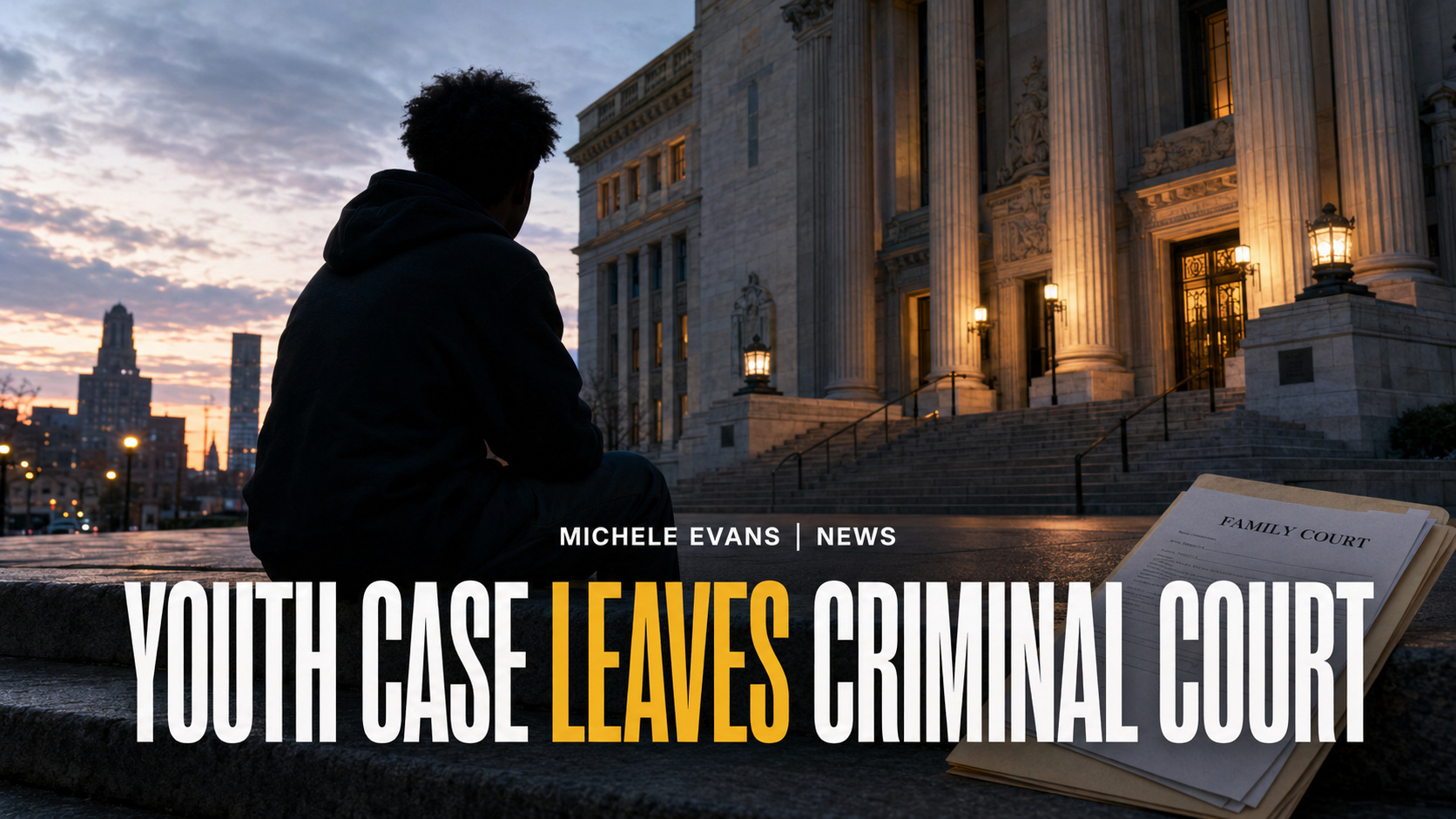
An Erie County judge has ordered a 17-year-old's gun-possession case transferred out of criminal court after prosecutors failed to prove the extraordinary circumstances required to keep it there under New York's Raise the Age law.
The decision does not dismiss the allegations and does not decide whether the teenager possessed any weapon. It changes the forum. The case will proceed in Family Court, where the law directs most adolescent-offender cases unless prosecutors meet a demanding statutory burden.
The teenager, identified in the court record as Damarion C., faces two felony counts of third-degree criminal possession of a weapon and one felony count of criminal possession of a firearm. He is presumed innocent. Youth Part Judge Brenda M. Freedman ruled on July 13 that the prosecution had not shown the highly unusual facts or lack of amenability to services needed to block removal.
Police executed a search warrant at the teenager's home on May 28. The warrant targeted his adult brother and authorized a search of the premises and people there, according to the decision. Officers recovered a loaded Glock pistol from a closet in one upstairs bedroom, a large-capacity magazine from the floor of another bedroom, and a second magazine and an auto sear attachment from a dresser drawer.
None of those items was recovered from the teenager's person. The court said the record did not establish whether either bedroom belonged to him. The opinion also questioned why he was arrested while his mother and another female occupant were not, though the decision did not make a finding of discriminatory enforcement.
Laboratory testing established that the pistol was operable. Prosecutors requested DNA testing on June 2, but the results were not available when the removal issue had to be decided. The state argued that transferring the case before those results arrived would undermine public confidence, reduce consequences, and increase the risk of recidivism.
The defense countered that firearm possession alone did not establish extraordinary circumstances. It argued that the teenager was not the target of the warrant and that police rushed to charge him because he was a male occupant in the house. Those are defense claims, not findings that investigators acted improperly.
Raise the Age generally treats 16- and 17-year-olds charged with felonies as adolescent offenders. After arraignment, the Youth Part must send a case to Family Court unless prosecutors move within 30 calendar days and prove extraordinary circumstances. Courts examine both the alleged offense and the individual young person's history, needs, role, and capacity to benefit from Family Court services.
The Legislature did not define extraordinary circumstances in a single phrase. Courts have looked to whether the facts are highly unusual and heinous and whether strong proof shows that the young person would not benefit from Family Court's heightened services. The test is intentionally more demanding than showing that the charged conduct is serious.
Judge Freedman found that prosecutors did not meet that test. The adult brother, not the teenager, was the intended target of the search. The gun and magazines were found in separate bedrooms rather than on him. Prosecutors did not allege that he was the ringleader of a crime, and the record left basic questions unanswered about control of the rooms and the decision to arrest him.
The judge also found no showing that the teenager was beyond the reach of Family Court. This was his first case in Youth Part. Prosecutors did not cite a history of police contact, and the court had received no negative report from probation after releasing him to supervision at arraignment.
The pending DNA test exposed a procedural pressure point. The court acknowledged that prosecutors may struggle to obtain forensic results within the law's 30-day extraordinary-circumstances timetable. But the statute does not pause that deadline while a laboratory works. The absence of results could not become proof against the teenager or a reason to hold the case in criminal court indefinitely.
That gap raises an accountability question for prosecutors and public laboratories. If the state wants forensic evidence to influence a Raise the Age retention decision, agencies need a process capable of producing reliable information before the statutory clock expires. A delay in government testing cannot quietly lower the burden the Legislature imposed.
The ruling also draws a line between public-safety concern and legal proof. A loaded firearm and high-capacity magazines are serious. But seriousness alone does not establish who possessed the items, who controlled the rooms where they were found, or why a particular young person cannot benefit from rehabilitation. Those questions must be answered with evidence, not assumption.
What changed is the state's ability to prosecute this 17-year-old as an adolescent offender in criminal court. Prosecutors had the burden to justify that exception. On the record before the judge, they did not.
For New Yorkers, the case is a reminder that reform laws are tested at their hardest point, when the allegations are alarming and evidence is incomplete. Raise the Age requires courts to look beyond the charge and examine the young person, the proof, and the possibility of rehabilitation. The judge enforced that command.
Leave a Reply