
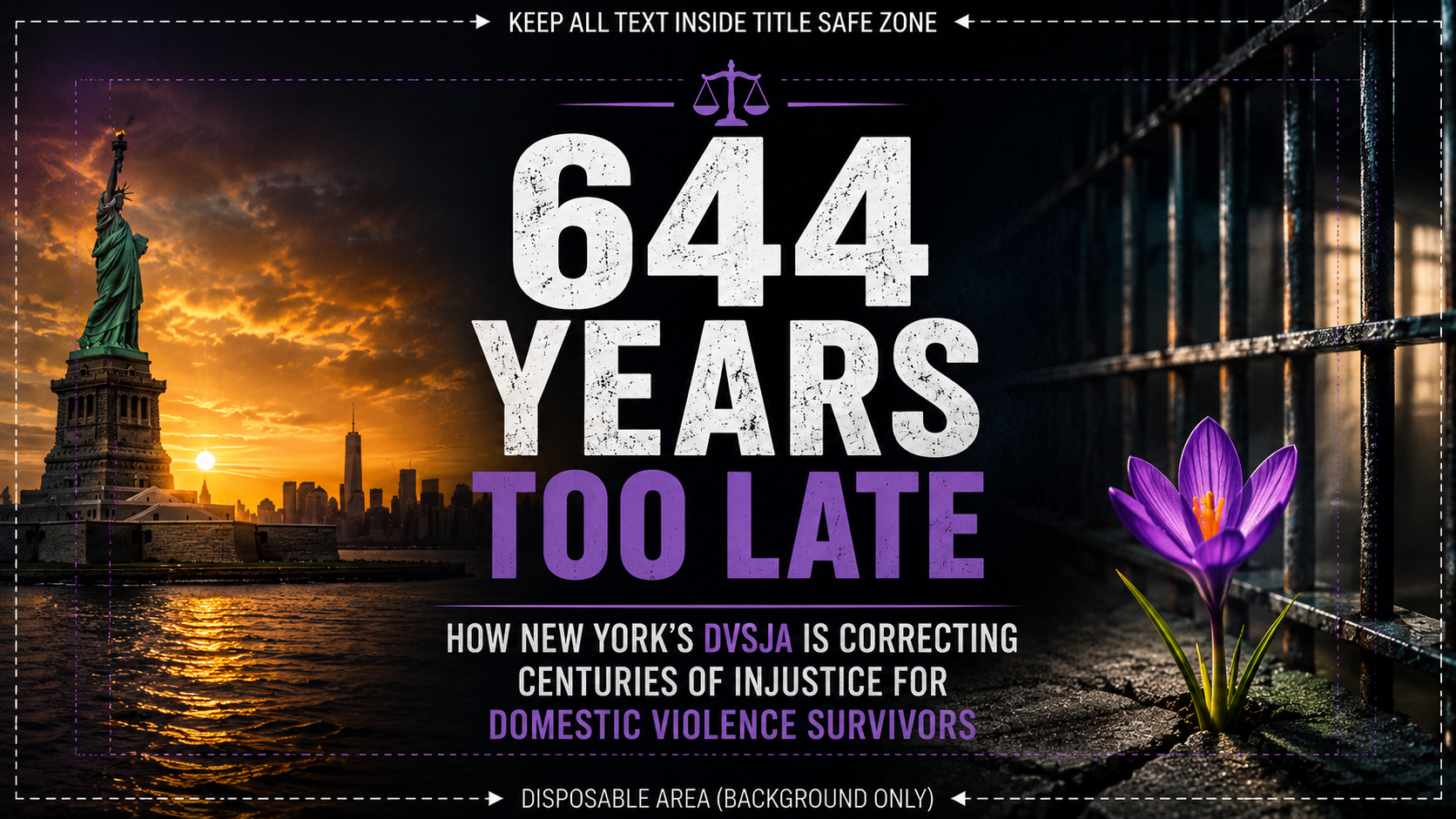
644 Years Too Late
By Michele Evans
New York City, New York
July 10, 2026
Category: Domestic Violence Survivors Justice Act / Criminal Justice / Survivor Justice / New York Courts / Decarceration
NEW YORK CITY, NY — The number should stop New York cold.
More than 644 years.
That is how much prison time could have been avoided if survivors had originally been sentenced under New York’s Domestic Violence Survivors Justice Act, according to the Survivors Justice Project. Not shortened later. Not corrected after years of separation, trauma, prison, appeals, applications, hearings, and rebuilding. Avoided.
The Survivors Justice Project reports that 85 survivors have been resentenced after filing DVSJA applications. Those resentencings have saved more than 248 years of needless incarceration from what would have been survivors’ earliest possible release dates. They have also eliminated 21 potential life sentences.
Those numbers are progress. They are also an indictment.
Because every year counted in that 644-plus figure represents time someone could have spent raising children, caring for parents, working, healing, studying, grieving, resting, creating, and living. Instead, those years were spent inside prisons by people whose histories of abuse should have mattered at sentencing from the beginning.
I know what that means because I lived it.
I am a DVSJA survivor. I know what it feels like to stand in a courtroom with a life shaped by violence and still watch the system flatten that life into a case number. I know what it feels like for survival to be misunderstood, minimized, or treated like an inconvenience to the prosecution narrative. I also know what it means when the DVSJA finally does what it was supposed to do: force the court to see the abuse, the coercion, the danger, the trauma, and the impossible choices that came before the charge.
But relief years later is not the same as justice on time.
The Domestic Violence Survivors Justice Act was supposed to recognize that abuse changes everything. It gives judges a way to impose reduced sentences when a survivor’s abuse was a significant contributing factor to the offense and when a standard sentence would be unduly harsh. That is not a loophole. It is not a free pass. It is a correction to a system that has punished too many survivors for the very circumstances they were trying to survive.
The horror is not only that people were sentenced harshly. The horror is that hundreds of years were imposed on survivors that, by the logic of the law itself, did not have to happen.
Over 600 years is not a clerical error. It is a generational wound.
It means children grew up while their mothers were gone. It means survivors aged behind walls while the law slowly caught up to what advocates, families, and incarcerated survivors had been saying for years. It means communities absorbed the cost of incarceration instead of receiving the benefit of healing, housing, treatment, legal support, and safety planning.
And yet, there is another story rising alongside the damage.
Last week, I was on a welcome-home meeting with more than 27 DVSJA survivors. That room mattered. It was not just a meeting. It was proof that the survivor community is growing, organizing, and refusing to let anyone come home alone.
There was joy in that space. There was pain, too. There always is. People do not simply walk out of prison and become whole because a judge finally says the sentence should have been different. Release is not a rewind button. It does not restore missed birthdays. It does not give children back the years they spent waiting. It does not erase the isolation, the prison discipline, the medical neglect, the stigma, the fear, or the paperwork battles.
But welcome-home spaces do something courts cannot do. They say: we see you. We believe you. You are not the worst thing that ever happened to you. You are not alone.
That is why the DVSJA is bigger than a statute. It is a test of whether New York can admit that criminalized survivors have been overpunished, underheard, and too often written off until advocates forced the record open.
The Survivors Justice Project’s data shows both the power and the failure of the law. Eighty-five resentencings is a powerful number because each one represents a survivor whose sentence was finally reconsidered. But 644-plus avoidable years is the number that should keep policymakers, prosecutors, defense attorneys, judges, and the public from congratulating themselves too quickly.
A law that works only after years of incarceration is still arriving late.
The next phase cannot be just celebrating resentencings after the damage is done. The next phase has to be front-end justice. Judges need to identify DVSJA eligibility before sentences are imposed. Defense attorneys need the resources and training to build abuse histories fully. Prosecutors need to stop treating survivor context as an excuse and start recognizing it as evidence. Courts need to move applications faster. And lawmakers need to keep listening to the people who lived this, not just the institutions that processed them.
New York has already accepted the principle behind the DVSJA: abuse matters. Trauma matters. Coercive control matters. Survival matters.
Now the system has to act like it believes that before another survivor loses years they should never have lost.
The DVSJA cannot give anyone back 644 years. It cannot return the childhoods, holidays, funerals, graduations, jobs, homes, relationships, or health that incarceration took. But it can stop New York from adding more years to that shameful total.
That is the measure now.
Not how many survivors the system eventually corrects.
How many it stops from overpunishing in the first place.
© 2026 Michele Evans News. Independent journalism and public-interest reporting by Michele Evans. All rights reserved.
Michele Evans is an independent journalist, author, and former ESPN technical producer whose work has appeared in The New York Times.
Michele got her start in 2001 covering the NBA and NFL.
She now covers New York City courts, criminal-justice procedure, NYPD, FDNY, domestic-violence systems, media accountability, public safety, advocacy efforts, and New York civic life through courthouse observation, public records, legal analysis, and lived-experience reporting.
Read more independent journalism by Michele Evans.
Follow Michele Evans on Facebook and Substack for new reporting, analysis, and updates.
Leave a Reply