
By Michele Evans
New York City, New York
Date: 7/9/2026
Category: NYPD / Child Protection / Sexual Violence / Police Accountability / Brooklyn Courts / Public Safety
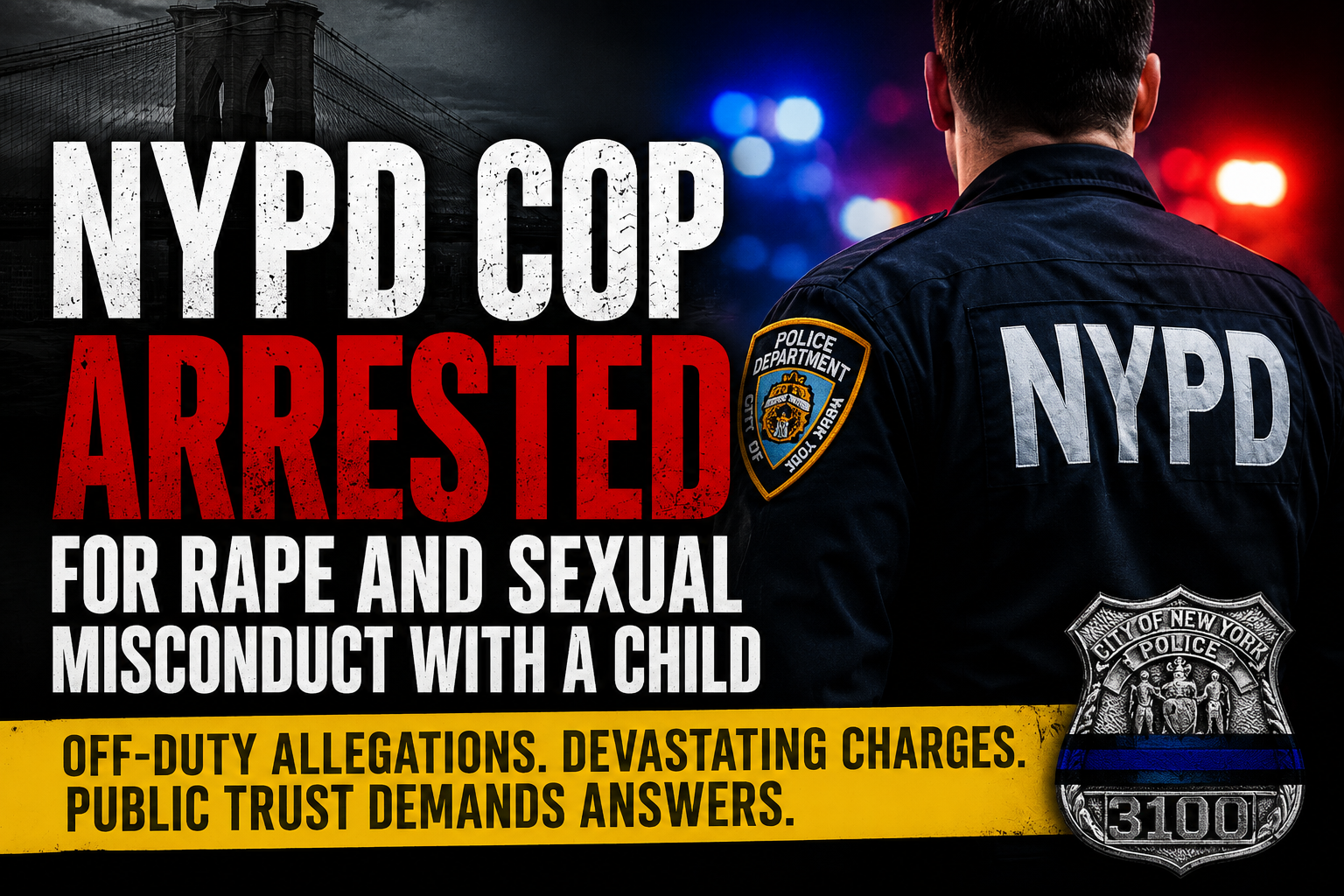
NEW YORK CITY, NY – An NYPD officer has been arrested on charges involving rape and sexual misconduct with a child, a case that demands more than a brief suspension notice and a criminal docket number.
The New York Daily News reported July 9 that Officer Joshua Acosta, 39, was taken into custody Wednesday night and charged with three counts of rape, three counts of sexual misconduct, acting in a manner injurious to a child, and course of sexual conduct against a child.
The allegations are horrifying. They are also charges, not convictions. Acosta is entitled to due process. The child is entitled to protection, privacy, and the full force of a justice system that too often fails young victims before they ever reach a courtroom.
According to the Daily News, police said the alleged crimes occurred in Brooklyn over several years while Acosta was off duty. Police also said the case is considered domestic, meaning the victim is alleged to be a relative or someone living with him.
That detail matters.
When alleged sexual violence against a child happens inside a domestic setting, the risk is not just the act itself. It is access. It is dependency. It is fear. It is the possibility that a child may have to survive in proximity to the very person accused of harming them.
That is true in any household. It is even more urgent when the accused person is a police officer.
Acosta worked in the NYPD Legal Bureau, according to the Daily News, and was suspended after his arrest. That placement raises public-interest questions that go beyond one criminal case. A police officer assigned to a legal unit understands procedure, investigations, language, liability, and the power of institutions. The public deserves to know how the department reviews warning signs, handles internal reports, and protects vulnerable people when the accused is one of its own.
The NYPD cannot treat this as merely an off-duty allegation. The badge does not disappear when a shift ends. Police power follows officers into courtrooms, homes, neighborhoods, custody disputes, domestic situations, and every space where credibility can shape whether a victim is believed.
That is why this case cuts so deeply.
A child-sex-abuse allegation involving a police officer is not only a criminal matter. It is a trust matter. It is a family-safety matter. It is a question of whether institutions that ask the public for cooperation are prepared to confront alleged harm inside their own ranks with the same urgency they demand from everyone else.
The law must decide what happened. But the public can already ask what systems were in place before the arrest, what supervisors knew, whether any prior complaints existed, whether the alleged victim had protection, and how long the alleged conduct went undetected.
Those questions do not presume guilt. They demand accountability.
New York has seen too many stories where power surrounds violence and silence follows. Survivors know the pattern. Children know the fear. Families know the pressure. Institutions know how quickly language can become a shield: suspended, reassigned, under investigation, personnel matter, no further comment.
Those phrases are not enough here.
If the allegations are proven, this case will represent a devastating breach of trust by someone sworn to protect the public. If the allegations are not proven, the process still must be transparent enough for New Yorkers to understand how the department responded and how the courts handled the case.
For now, the confirmed facts are limited. An NYPD officer has been arrested. He faces serious charges involving a child. The alleged crimes are described by police as domestic. He has been suspended. The case now belongs to the criminal legal system.
But the larger question belongs to the city.
When a child is allegedly harmed by someone carrying a badge, New York should not look away. It should ask harder questions, demand clearer answers, and remember that public safety begins with protecting the people least able to protect themselves.
Michele Evans is an independent journalist, author, and former ESPN technical producer whose work has appeared in The New York Times.
Michele got her start in 2001 covering the NBA and NFL.
She now covers New York City courts, criminal-justice procedure, NYPD, FDNY, domestic-violence systems, media accountability, public safety, advocacy efforts, and New York civic life through courthouse observation, public records, legal analysis, and lived-experience reporting.
Read more independent journalism by Michele Evans.
Follow Michele Evans on Facebook and Substack for new reporting, analysis, and updates.
Leave a Reply